

![[object Object] icon](/_next/static/media/home.59b745c9.svg)

![[object Object] icon](/_next/static/media/buy.57cae078.svg)
![[object Object] icon](/_next/static/media/rent.2864d22a.svg)
![[object Object] icon](/_next/static/media/commercial.5f5f9bbc.svg)
![[object Object] icon](/_next/static/media/condos.8a55189e.svg)
![[object Object] icon](/_next/static/media/newLaunches.e1f1ccfd.svg)
![[object Object] icon](/_next/static/media/agents.9f8252e2.svg)
![[object Object] icon](/_next/static/media/guides.f567fc08.svg)
![[object Object] icon](/_next/static/media/contactUs.a39ef3b7.svg)
![[object Object] icon](/_next/static/media/aboutUs.e47cbd6d.svg)
)

Renting vs Buying Property in Malaysia: What Makes Sense in 2026?
Key Takeaways
- Affordability Pressure: Rising property prices and slower wage growth are making homeownership harder for many Malaysians.
- Renting Flexibility: Renting offers lower upfront costs and greater mobility, especially for young professionals.
- Hidden Ownership Costs: Maintenance, taxes, and other expenses significantly increase the real cost of owning property.
- Lifestyle Matters: The decision is not purely financial—it also depends on personal goals and mobility preferences.
- No Universal Answer: The right choice depends on your financial stability, time horizon, and lifestyle priorities.
The Big Question: Can Malaysians Still Afford to Buy?
The question of renting vs buying property in Malaysia has never been more relevant than it is in 2026. Across cities like Kuala Lumpur, Penang, and Johor Bahru, Malaysians—especially young professionals—are rethinking what it means to own a home.
Scroll through online communities, and one thing becomes clear: Malaysians are actively debating whether homeownership is still within reach, particularly in an environment shaped by rising costs and uncertain income growth1.
This reflects a broader shift. Property prices have increased over time, but wages haven’t always kept up at the same pace. For many, especially first-time buyers, saving for a down payment while managing daily expenses feels overwhelming.
At the same time, renting offers a lower upfront cost and more flexibility—making it an attractive alternative for those prioritizing financial breathing room2.
So the real question becomes: not just “Can you buy?” but “Should you buy?”
The Surprising Math Behind Renting vs Buying
At first glance, buying a home seems like the smarter long-term investment. You build equity, you own an asset, and you avoid “wasting money” on rent.
Not always. In some scenarios, the total cost of owning property can exceed renting costs, especially over shorter timeframes when interest payments and additional expenses are factored in3.
This challenges the traditional belief that buying is always financially superior.
The Hidden Costs of Homeownership
Many first-time buyers focus only on monthly loan repayments. But the real cost of owning property goes much deeper.
Additional expenses such as maintenance, taxes, insurance, and renovation can significantly increase the total cost of ownership, often catching buyers off guard4.
- Maintenance and repair costs
- Property taxes and assessment fees
- Insurance
- Renovation and furnishing
- Management or service charges for condos
Renters, on the other hand, typically avoid most of these expenses, making renting financially lighter in the early stages.
A Visual Breakdown of the Financial Trade-Off
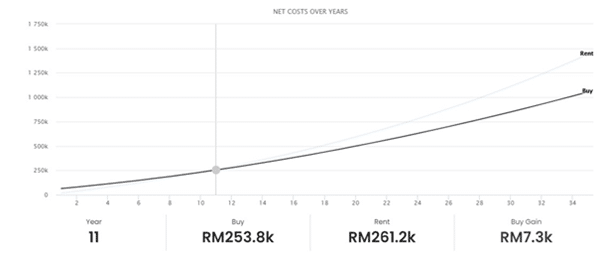
Comparison of long-term ownership costs versus rental expenses across different time horizons in Malaysia
The EPF Framework: 5 Questions to Ask Yourself
A practical way to approach this decision is by asking the right questions. A structured framework highlights affordability, income stability, and long-term plans as key considerations before committing to property ownership5.
- Can you afford the upfront and ongoing costs?
- How stable is your income?
- Are you planning to stay long-term?
- Do you have enough savings for emergencies?
- What are your lifestyle priorities?
These questions shift the focus from emotion to practicality, helping individuals make more grounded decisions.
Lifestyle vs Investment: What Are You Really Choosing?
One of the biggest misconceptions is that buying property is purely a financial decision. In reality, it is equally about lifestyle.
Renting offers flexibility and freedom, particularly for younger Malaysians who prioritize mobility, career growth, and experiences over long-term commitments6.
It can also free up capital for alternative investments such as stocks or businesses, offering different paths to wealth-building7.
Buying, however, provides stability, ownership, and protection against rising rental costs. Ultimately, the decision depends on personal priorities rather than a one-size-fits-all rule8.
What Young Professionals in Malaysia Are Thinking
Young professionals are increasingly delaying homeownership, influenced by rising property prices, job mobility, and evolving lifestyle preferences9.
This signals a cultural shift. Homeownership is no longer seen as an immediate milestone but rather a strategic decision that can be postponed.
The Role of Technology in Property Decisions
Technology is transforming how Malaysians evaluate renting and buying options. Digital platforms now allow users to compare prices, explore listings, and assess affordability with greater transparency10.
This access to data empowers individuals to make more informed decisions rather than relying on traditional assumptions.
Looking Beyond Malaysia: Is Property Still a Good Investment?
Some Malaysians are exploring property investment beyond local markets as part of diversification strategies, considering opportunities in international real estate11.
However, overseas investments come with additional risks such as legal complexities, currency fluctuations, and unfamiliar market conditions.
Renting vs Buying: A Simple Way to Decide
After considering all factors, the decision can be simplified into three core elements: time horizon, financial strength, and personal priorities.
- Time Horizon
- Financial Strength
- Personal Priorities
Each factor plays a critical role in determining which option aligns best with your situation.
The Bottom Line: There Is No “One Right Answer”
The debate around renting vs buying property in Malaysia is not about which option is universally better.
It is about what works best for you—based on your financial reality, lifestyle, and long-term goals. In 2026, Malaysians are becoming more thoughtful, weighing real numbers and personal priorities rather than following outdated assumptions.
Both renting and buying are valid paths. The smartest move is choosing the one that fits your life today.
Frequently Asked Questions
Question: Is renting cheaper than buying property in Malaysia?
Answer: In the short term, renting is often cheaper due to lower upfront costs and fewer additional expenses, but long-term costs depend on market conditions and personal finances.
Question: When does buying property make more sense?
Answer: Buying makes more sense when you have stable income, long-term plans to stay in one location, and sufficient savings to cover upfront and ongoing costs.
Question: Can renting still help build wealth?
Answer: Yes, renting can free up cash for other investments like stocks or businesses, allowing individuals to grow wealth without committing to property ownership.
Disclaimer: The information is provided for general information only. JYMS Properties makes no representations or warranties in relation to the information, including but not limited to any representation or warranty as to the fitness for any particular purpose of the information to the fullest extent permitted by law. While every effort has been made to ensure that the information provided in this article is accurate, reliable, and complete as of the time of writing, the information provided in this article should not be relied upon to make any financial, investment, real estate or legal decisions. Additionally, the information should not substitute advice from a trained professional who can take into account your personal facts and circumstances, and we accept no liability if you use the information to form decisions.
