

![[object Object] icon](/_next/static/media/home.59b745c9.svg)

![[object Object] icon](/_next/static/media/buy.57cae078.svg)
![[object Object] icon](/_next/static/media/rent.2864d22a.svg)
![[object Object] icon](/_next/static/media/commercial.5f5f9bbc.svg)
![[object Object] icon](/_next/static/media/condos.8a55189e.svg)
![[object Object] icon](/_next/static/media/newLaunches.e1f1ccfd.svg)
![[object Object] icon](/_next/static/media/agents.9f8252e2.svg)
![[object Object] icon](/_next/static/media/guides.f567fc08.svg)
![[object Object] icon](/_next/static/media/contactUs.a39ef3b7.svg)
![[object Object] icon](/_next/static/media/aboutUs.e47cbd6d.svg)


The Future of AI and Communication: Navigating a World of Automated Responses and Data Privacy
Key Takeaways
- AI Integration: Artificial Intelligence is increasingly shaping professional and personal communication, from job applications to healthcare.
- Automated Responses: The rise of AI leads to more automated interactions, posing challenges in maintaining a personal touch and receiving human feedback.
- Data Privacy Concerns: Extensive use of personal data by AI models raises significant issues regarding privacy, consent, and potential manipulation.
- Misinformation Challenge: AI's ability to create realistic fake content makes discerning truth from falsehood online more difficult, impacting public discourse.
- Critical Communication: In sensitive areas like health and disaster response, AI can assist, but human empathy and clarity remain irreplaceable.
- Emphasis on Clarity: Clear human intent, understandable AI output, and robust ethical guidelines are crucial for effective and responsible AI-driven communication.
Welcome to the exciting, and sometimes a little bit confusing, world where Artificial Intelligence (AI) meets human communication! Every week, new breakthroughs in AI shape how we talk, work, and even how we understand ourselves and the world around us. This week, we're diving deep into The Future of AI and Communication: Navigating a World of Automated Responses and Data Privacy. From getting a job to understanding health news, AI is changing everything. But with these big changes come big questions, especially about how we deal with automated messages and keep our personal information safe.
Imagine a world where your job application is read by an AI, your doctor uses AI to help explain your health, and even the news you see is shaped by AI. This isn't science fiction; it's happening right now! Let's explore how AI is reshaping our conversations, the tricky parts of this new world, and what it all means for you.
AI in the Professional World: Decoding Digital Doors and Automated Replies
When you're looking for a job, you’re already stepping into a world where AI plays a big role. Think about it: you spend hours perfecting your resume and cover letter, hoping to make a good impression. But who reads it first? Often, it's not a human. AI systems often scan applications to find keywords and decide if you're a good fit for the next step.
This means that even before you get to speak to someone, AI has made a decision about you. And when you get a rejection letter, it can be hard to know what really happened. Was it a person’s choice, or an automated system? Sometimes, these letters can feel very impersonal. Understanding the language of rejection letters can be tough, as they often use polite but vague terms like, "It's not us, it's you" – which really means trying to understand the nuanced language used in such messages1. It’s a challenge to get real feedback when a machine might have been the first to say "no."
Many people feel frustrated with online job platforms, like LinkedIn. Some users have openly wondered, "What the f*** happened to Job Search on LinkedIn?"2. This suggests that even popular platforms, meant to connect people, can sometimes make job seeking feel more confusing and less human, perhaps due to the increasing layers of automation. It leaves candidates guessing if they received an automated rejection email after applying, with messages like, "'Unfortunately, we will not be moving forward with your application...'"3.
It's not just job hunting. Even in school, communication is changing. Students learn how to send emails to their professors that are clear, polite, and get their message across without being "annoying AF," as one guide humorously puts it4. This shows that even simple, formal communication needs careful thought, especially when dealing with busy people who might skim emails quickly – much like an AI might.
The rise of AI tools in offices, like smart assistants that schedule meetings or programs that draft emails, means we're relying more and more on machines to help us communicate. While this can make things faster, it also makes us wonder: are we losing the personal touch? Are we becoming too reliant on algorithms that might miss the subtleties of human language? The careful crafting of a message, the empathy in a response, or the personal connection often made through communication – these are things we must ensure don't get lost in the age of automated efficiency. For insights into how AI is also impacting other industries, consider exploring "AI and Property Data Analytics: Unlocking the Future of Real Estate"5.
The Digital Wild West: Online Content, Misinformation, and the Fight for Data Privacy
Beyond the professional world, AI is deeply woven into the fabric of the internet itself. From the news articles you see, to the social media posts you scroll through, AI algorithms are constantly at work, deciding what to show you. While this can personalize your online experience, it also brings up big questions about what we’re truly seeing and whether it’s always true.
Many people are starting to feel that "Something is wrong on the internet"6. This feeling comes from concerns about how content is made, shared, and sometimes even twisted online. AI can create incredibly realistic fake images, videos, and text, making it harder than ever to tell what's real and what's not. This problem, often called misinformation or "fake news," is a huge challenge in our digital age. It can change how people think, influence elections, and even affect public health.
At the heart of many AI systems is data – your data. Every time you click, type, or interact online, you’re creating data that AI models can use to learn. This raises serious concerns about data privacy. People are increasingly worried about companies using their personal information to train powerful AI models without their full understanding or consent. For example, some users have expressed their concerns about filling objection forms to companies like Meta, who use their information to train Meta AI7. This shows a growing public awareness and demand for control over personal data in the age of AI. To understand how AI is revolutionizing various sectors through data and intelligence, consider reading "Decoding Tomorrow: How AI-Driven Property Intelligence is Reshaping Real Estate".
The more AI learns from our data, the more it understands our preferences, habits, and even our vulnerabilities. This can lead to highly targeted advertising, but also raises ethical questions about manipulation and surveillance. Protecting our personal information and understanding how it's used is becoming one of the most important fights in the digital world. It’s about more than just privacy; it’s about maintaining control over our digital selves.
It's clear that online communication, while connecting us in amazing ways, also brings challenges to our mental well-being, especially when things like cyberbullying arise.
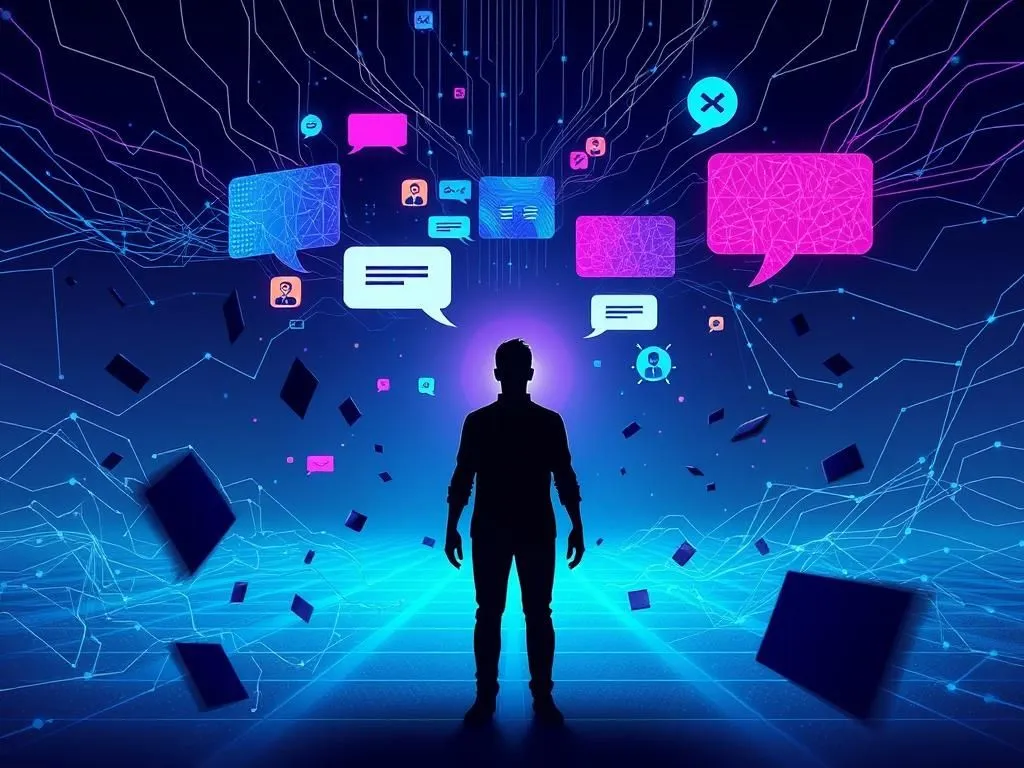
An image illustrating the impact of negative online experiences on mental well-being, showing how they can contribute to feelings of sadness, anxiety, and loneliness.
This image serves as a powerful reminder that while AI and digital platforms connect us, they also create new spaces where harm can occur. Ensuring safe and respectful online communication, free from harassment, is a critical area where human values must guide technological development.
AI's Role in Health and Critical Communication: When Every Word Matters
Beyond everyday online interactions, AI is making its way into very sensitive areas, like healthcare and emergency response. In these fields, clear and accurate communication isn't just helpful; it can be life-saving.
When people are dealing with health issues, they often turn to online communities to share experiences and find information. Platforms like Mayo Clinic Connect provide a space for people to discuss symptoms, treatments, and feelings, asking questions like "Tapering Pains Body Response or PMR?"8. While AI can help organize this information and suggest relevant topics, the human connection and empathy in these discussions remain vital. AI might help analyze large amounts of health data to spot trends or provide summaries, but it's the personal stories and shared understanding that truly support individuals.
In disaster response, clear and effective communication is absolutely crucial. When a crisis hits, nurses and other frontline workers face immense challenges. A qualitative study highlighting "Nurses' challenges for disaster response" points out how important it is for them to communicate effectively under pressure, coordinating with teams and comforting those in need9. In such high-stakes situations, AI could potentially help by analyzing incoming information, translating languages, or even predicting where resources are most needed. However, the core of disaster communication relies on clear, human-to-human interaction, where empathy and precise instructions are paramount.
Even the language used in official documents, like government contracts, needs to be crystal clear. "Part 52 - Solicitation Provisions and Contract Clauses" from the Acquisition.gov website highlights the importance of well-defined terms in public sector agreements10. In the future, AI could help draft these complex documents, checking for clarity and consistency. But the ultimate responsibility for ensuring that contract language is unambiguous and fair will always rest with humans. The human ability to understand context, foresee potential misinterpretations, and negotiate nuanced terms is irreplaceable.
The integration of AI in these critical communication areas means we need to ensure that the technology supports, rather than replaces, the essential human elements of care, clarity, and compassion. AI tools can be powerful aids, but they must be designed and used in a way that enhances our ability to communicate effectively when it matters most.
Defining the Future: Clarity and Understanding in an AI World
As AI continues to shape our communication, one thing becomes incredibly important: clarity. For humans to understand each other, and for AI to understand us and respond accurately, we need clear definitions and precise language.
Think about how important it is to define terms in complex fields. For example, in the study of people moving from one country to another, understanding "Key Migration Terms" from the IOM, UN Migration glossary is essential11. Without agreed-upon definitions, discussions can become confused, and important decisions can be based on misunderstandings.
This need for clarity applies just as much to AI. When we give instructions to an AI, or when an AI gives us information, any ambiguity can lead to errors or unintended consequences. If an AI helps write a job description, but the terms are vague, it might attract the wrong candidates. If an AI helps generate health advice, but the language is unclear, it could be dangerous.
The future of AI and communication relies on our ability to create clear systems. This means:
- Clear Human Intent: We must be precise in what we want AI to do.
- Clear AI Output: AI systems must communicate their information and decisions in ways that are easy for humans to understand.
- Clear Ethical Guidelines: We need clear rules about how AI uses our data and how it influences our communication.
As AI develops, it will become even more skilled at understanding and generating human language. But this makes our role as humans even more vital. We need to be the guardians of clarity, ensuring that while AI makes communication faster and more efficient, it also remains accurate, understandable, and truly helpful. The goal isn't just more communication, but better communication.
Looking Ahead: Our Role in Shaping the AI Conversation
The Future of AI and Communication: Navigating a World of Automated Responses and Data Privacy is not just about technology; it's about us. It's about how we choose to build, use, and interact with the powerful tools AI offers. We've seen how AI is changing everything from finding a job to getting health advice, and the big questions it raises about data privacy and misinformation.
The journey ahead will be full of innovation and challenges. We'll see AI get even smarter, capable of more complex conversations and more nuanced understanding. But the core of communication – the desire to connect, share, and understand each other – will always remain human.
Our responsibility is to ensure that as AI grows, it serves human values. This means demanding transparency in how AI works, protecting our data fiercely, and using AI to foster clearer, more empathetic, and more truthful communication, rather than less. It means teaching the next generation to be critical thinkers online and to understand the power of their digital footprint. Reflecting on AI's broader impact on society and its potential for positive change requires considering both ethical and practical implications. The future isn't just something that happens to us; it's something we create together. By being curious, asking tough questions, and staying engaged, we can navigate this exciting new world, ensuring that AI enhances our ability to communicate, connect, and thrive, rather than complicating it. Let's make sure that in this future, our voices, and our data, are always heard and protected.
Frequently Asked Questions
Question: How does AI influence job applications?
Answer: AI systems often scan job applications for keywords and qualifications, determining which candidates move forward, sometimes before a human reviews them.
Question: What are the main concerns regarding data privacy with AI?
Answer: Key concerns include companies using personal information to train AI models without full understanding or consent, leading to potential manipulation, targeted advertising, and surveillance.
Question: How can individuals ensure clear communication in an AI-driven world?
Answer: Individuals should strive for precise intent when interacting with AI, demand clear and understandable outputs from AI systems, and advocate for clear ethical guidelines regarding AI's use of data and influence on communication.
Disclaimer: The information is provided for general information only. JYMS Properties makes no representations or warranties in relation to the information, including but not limited to any representation or warranty as to the fitness for any particular purpose of the information to the fullest extent permitted by law. While every effort has been made to ensure that the information provided in this article is accurate, reliable, and complete as of the time of writing, the information provided in this article should not be relied upon to make any financial, investment, real estate or legal decisions. Additionally, the information should not substitute advice from a trained professional who can take into account your personal facts and circumstances, and we accept no liability if you use the information to form decisions.
